Proceed with caution; there are spoilers as you enter the arena, my gladiators.
I had the pleasure of seeing a preview of Gladiator II at the beginning of November, and it was certainly an experience watching this action filled motion picture on the biggest screen one could find in my vicinity. [I have now seen it twice] The soundtrack and sound design had the theatre shaking, aiding in making one believe one had just entered into Roman times themselves. It was a glorious beginning of a movie as the beginning credits, recounting important scenes from the first movie, started rolling. I believed I was going to witness one of the greatest sequels in movie history.
The film promises epic fights and delivers those in an absolute multitude and magnitude. The audience can never relax as Hanno aka Lucius, aka the Gladiator, aka the Prince of Rome (Paul Mescal) is thrown into fight after fight, barely making it out sometimes. We start empathising with the young man who has lost everyone he loved as the film progresses (at least he thought so), we follow him as he is slaved out and having to fight his way to being a free man again.
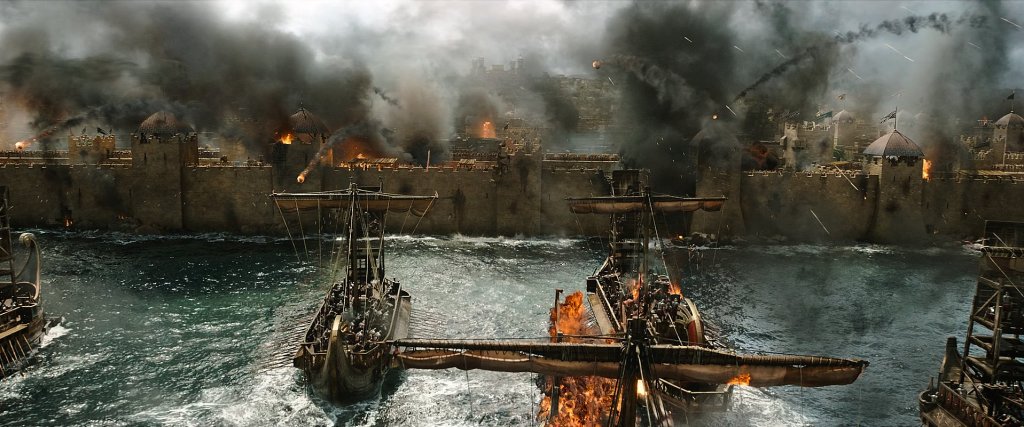
The film immediately throws us into a battle and, breathing heavily, the audience is on the edge of their seats as one can only assume something sinister will be happening. General Marcus Acacius enters the scene and leads his army to conquer Lucius’ home. I couldn’t contain my excitement of seeing my beloved Pedro Pascal in a Ridley Scott spectacle. He commanded the room by simply saying one sentence, the audience loved Pascal.
If it is one thing Scott can do and excels at, then it is creating the atmosphere of war and making the audience a fly on the wall as two opposing sides obliterate each other. He does so by orchestrating cinematic war zones that make the audience squirm in their seats as they are bombarded with slashing, bashing in of heads, blood everywhere, arrows and canon balls flying through the air, men screaming in agony and heroes surviving despite the odds. What he doesn’t do is make the characters invincible, they gain their battle scars as the film progresses. He is secure in making action sequences that show humans actually becoming fatigue and not being superhuman, it adds humanity to a film like this.
One thing I would like to speak on though was the interesting CGI we had to see every once in a while, it kicked you out of the film as fast as the cinematography immersed you in it in the first place (I think about those killer baboons and sharks on a daily basis actually, especially the scene where Lucius bites a baboon and then kills it by strangling it with his chains, incredibly interesting…).
Scott banked on the action sequences to bring in the audiences, and they did, but as someone who loves good fucking cinema, the writing is the one thing that needs to exceed my expectations. I am a writer, so forgive me, but the script is the blueprint for an exceptional movie. Action filled sequences bring you the audience, but the script is what makes them fall in love with cinema.
The movie lacks in the writing department. The dialogues are mostly devoid of depth and it seems as if they got shortened to make space for the continuous bloodbath. I have now seen the movie twice and what I can say is that the dialogue scenes now felt more complete than on my first watch. On this one I was not so blown away and bombarded by the fight and war sequences so I could pay more attention to what the characters were saying to each other. But still, the writing is sadly lacking. It is as if the continuous bloodbath was there to distract from the dialogue. I know I’m watching a Gladiator movie, so the fighting needs to be taking up space and entertain the masses but don’t tell me Gladiator (2000) with Russell Crowe wasn’t more emotional and had a better script. But after all it is still a blockbuster, it can’t help it if you think about it. We didn’t sit down to watch a dramedy, we knew what we were getting ourselves into, but it would have certainly been a big plus if the action was accompanied by profound writing.
Absolute historical accuracy is not something you should be expecting from a Ridley Scott epic, we should know that by now. Scott has made that abundantly clear by hurling insults at anyone paying attention (so I will refrain from telling you about the man who was reading a newspaper in Ancient Rome when the printing press got invented 1200 years after, whoops). One thing I gotta applaud him for is the casting, especially of thee Gladiator.
The characters themselves appeared incredibly thought through. They seemed interesting, as if they had stories to tell; they had their own quirks and as I left the cinema I was hoping we get to explore those in later sequels, and then it hit me that the only one of the main cast surviving was in fact Lucius… so that will be challenging I fear. My question is really only why the writing doesn’t show the characters’ multidimensional personalities.
One always loves when a villain meets a dreadful ending, but having at least one of them make it until the next movie would have given Gladiator III a big advantage. Lucius would have a bigger desire for vengeance and finding whoever it was who had a say in destroying Rome and murdering his loved ones, but they’re all dead, so that is done and dusted.
The character development, especially of Lucius, feels rushed as some scenes or maybe even whole sequences might have been cut to make room for men being men and fighting until death. That was certainly something the Romans loved to entertain, but deep conversations are truly missed. When characters do have a heart-to-heart conversation, one doesn’t really believe them when they are speaking. Especially Lucius seems like a shell of a person, something Maximus was not. First he hates everyone associated with the Roman Empire, it seems as if not even his mother, Lucilla, can get through to him and suddenly he positions himself in her favour and fights for her honour. Their one-on-ones don’t do what Scott wanted them to do. They rather make the audience confused as they seem to feel a bit lost because of Lucius himself not really knowing what or who he is actually fighting for. That could certainly be on purpose, but I do enjoy a protagonist who helps the audience gain a footing in the story, even if they’re lost themselves at first. As said above, when one doesn’t let the arena sequences cloud one’s perception it is easier to see past the facade Lucius has built up and see the young boy who thought he had lost everyone he has ever loved, but the general audience won’t have realised.
You get your trusted blockbuster, but the characters and their connections to each other seemingly get lost on the way a bit. They become shallow characterisations only there to combat the overflowing fighting scenes, so the critics can say dialogue was in fact used in the movie.
One thing that also stood out to me was May Calamawy disappearing into the background of shots, even though she was introduced as playing a major role in the sequel when they announced it. One doesn’t need to have glasses to see why exactly she got cut out of the movie. A pity really as she would have done a great job. I am hoping to see her in the third film as she could be an interesting character having had a past marked by Macrinus (hear me out).
Joseph Quinn played the vicious and narcissistic Emperor Geta. He can play a little freak really well and I would like to emphasise that it would have been glorious to have had him as a known antagonist in the next movie. The now lone emperor, who becomes even more evil and conniving, could have raised the stakes as all the pent-up anger on both sides could have made for a third movie to overtake this sequel immediately. Also, I just like seeing Joseph employed, what can I say. The only thing that keeps me at bay is that the Roman Empire was piled with evil and conniving men wanting to experience power, so at least next time we can meet another emperor or noble man that we can hate in peace (I suggest Christoph Waltz).
Fred Hechinger, most certainly a force to be reckoned with in future years, plays Caracalla, the brother of Geta, and he did so well at playing the spoiled little brat with a personality problem. I am excited to see what else his career brings, since he embodied Joaquin Phoenix’s energy to perfection. It was like going back in time and seeing a younger and more impressionable Commodus.
We had an evil mastermind grace the screen. One could have seen it coming but decided against it since Macrinus was played by the legendary Denzel Washington. Macrinus, the man who promised Lucius to make him a free man, being the hidden antagonist was a move that should be applauded. It is a shame he met a gruesome death, because one can genuinely understand why exactly he wanted to overthrow the empire. Sadly he tried doing so with violence and that is where he went wrong. His ending, which functioned as one of the climax sequences, seemed rushed since every single character played by an A-list actor needed to be introduced singularly (someone cue the applause track). This losing precious running time for scenes that needed it.
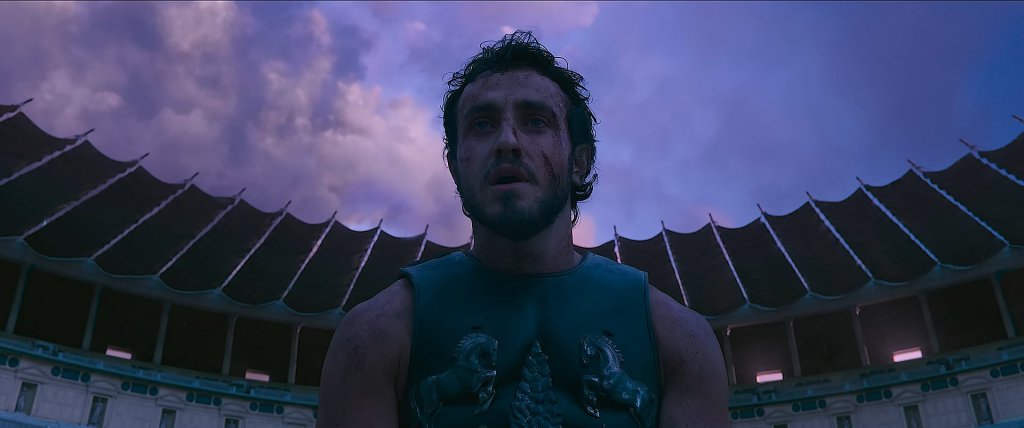
Paul Mescal has the star power to lead a franchise and I am beyond excited what will happen in the next chapters of Lucius’ story. He commanded the room and the arena, even though his English accent always feels like a jump scare to a fellow Irish person. I hope the next film takes inspiration from Russell Crowe’s Maximus, as his son Lucius needs to also become a fully fleshed out character. Being famous for his heart-wrenching roles in indie projects and incredible physicality, Mescal showed he was fit for the challenge to become a blockbuster leading man. He has said he doesn’t want this to define his career, but having a movie franchise like that under his belt must feel fantastic. People were astonished when Scott said he had binged Normal People and envisioned Paul as the future Gladiator, but the series just showcases how hypnotising and in touch with his emotions Mescal actually is. Now imagine that combined with action filled sequences. Both characters are deeply hurt individuals, the pain being caused by opposing mindsets. Connell Waldron paved the way for Lucius Verus. To top it off, Mescal must have the most Roman features in present time, aiding in making us immerse ourselves in the past.
Lucilla (Connie Nielsen) actually became one of my favourite characters in the movie. That is probably because she functions as the bridge to the original. She is a multidimensional character, as we got introduced to her twenty-four years ago. She might be the heart of the movie, connecting Paul’s gladiator to Russell’s in a heart-warming way. It is her person who connects new and old characters. Which might make her passing even more heartbreaking. She is married to the iconic Marcus Acacius in this one, and Pedro Pascal devoured his screen time. At first Acacius appears as a stoic character but that facade quickly slips as he finally sets foot back in Rome and gets to be with his wife, life seems to make sense again. Lucius on the other hand wants him to pay for indirectly killing his wife, Arishat (What an unneeded character by the way, we could have cut her out and base his anger for the Roman Empire on them slaughtering the people who took him in as a child. The dead wife trope wasn’t necessary, especially since the actress gave us nothing). The General being married to Lucius’ long-lost mother, certainly gives for an interesting plot.
The tremendous scene as Marcus Acacius is sent into the arena after committing treason hasn’t left my mind. Pascal can most definitely fight, even though he always complains to be an old guy with horrid back pain. Maybe the back pain comes from him and Nielsen shouldering the emotional depth of the whole movie. I find it especially fascinating that a man of his statute, someone who laughs at any given opportunity, complimenting your nails can pull off someone like General Acacius, a character you would salute in front of or kneel to if he demanded it. His death scene might have been the most horrific scene in the movie for me, and that says a lot, as I had to see heads being cut off and then later exhibited for dramatic purposes.
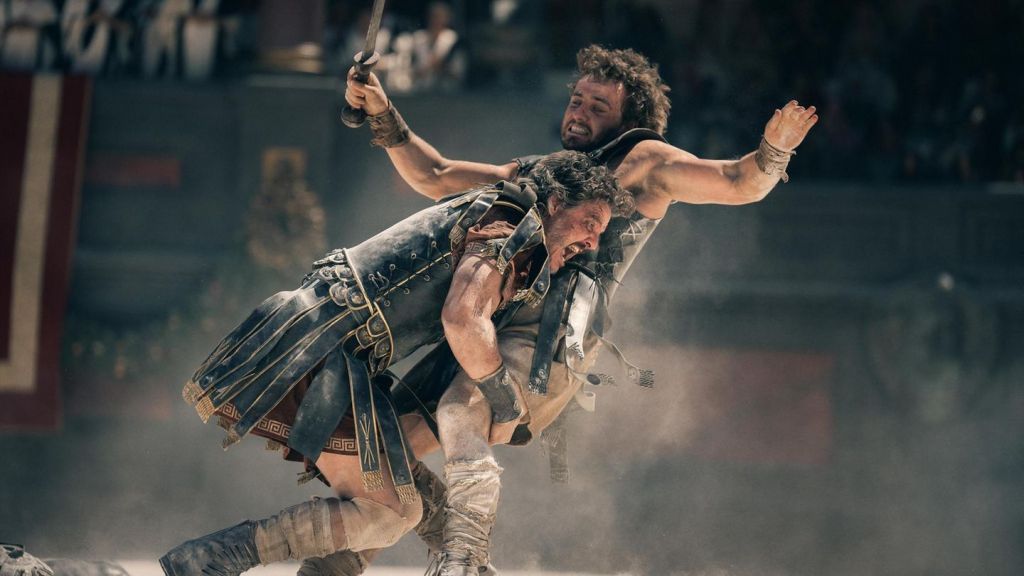
The dramatic fight between Lucius and Marcus Acacius is one of the best in the film as they are physically fighting and yet emotional depth is added right as Marcus Acacius is ready to die. The fight choreography is thought through, it is never certain who will win and who will die trying. Lucius is full of rage as Marcus is ready to resign as he cannot kill the lost child his wife had been grieving for more than twenty years just to survive himself. He kneels down to Maximus’ child, his late treasured comrade in arms. Telling Lucius he would have died for his late father flips a switch in the young gladiator’s mind. He cannot kill this man, he shows him mercy when he certainly did not need to show it since Acacius was at fault for getting his love killed and it appeared that Lucilla hadn’t been looking for him or cared for him all these years. Lucius finally became the master of his inner conflict. Instead of his uncle Commodus piercing through him and marking him, Maximus made his way through his troubled mind. He kneels down to the man he had once despised and wished death upon, and the audience cries out when the arrows pierce Acacius’ body. Lucius is enraged and delivers an honourable monologue, paving the way for the people of Rome to stand tall against the conniving emperors keeping them hostage in their once beautiful city. If the emperors killed this general what would they do to the citizens of Rome if they had the chance, what would the life of a normal citizen be worth if Marcus Acacius was murdered like an animal? A revolt commences.
This movie opens up a franchise discussion. In my eyes it did its job as a sequel as it most definitely sets up another movie and was entertaining. I am excited to see how the story develops. A new movie is undoubtedly needed, the audiences (me) are begging for it. We don’t see it often that a sequel is simply made in hopes of making a third film that can move away further from the original to make space for a new plot and then linking itself to the original when it sees fit (at least that appears to be the case here). The first Gladiator was more thought through and didn’t appear unambitious in the dialogue department. You felt a closer bond to the main character as you really understood his stance and were emotionally invested. (That being said, if the third movie goes ahead because I know Scott is currently writing it, Lucius will appear more fleshed out and we will get to experience a bond like we felt with Maximus.) The last fight to end it all served as an anchor point in the original whereas, the last fighting scene in this one just functioned to have the film end. Washington and Mescal did devour that though. The evil manipulator riding out on a white stallion, as the hero destined for a greater purpose gallops after him on a black horse. Lucius being the dark horse in this race and becoming the unexpected winner, not for the audience, but to the Roman Empire.
There is so much more one could say and multiple viewings will be needed to delve fully into stylistic choices and characters. There are indeed some analysis worthy quotes in the movie but I will let you be the captain of your own ship. As Paul Mescal said: grab your friends, go out for dinner and then sit down and be catapulted back into Roman times. I am excited how the story continues and how Lucius works through his trauma. This is a good movie and here’s to hoping the third movie will be great. (Maybe the female gaze could be added by seeking help from a female writer, hint hint) One thing is for sure though, Gladiator (2000), you will always be famous.
 Art Of Pretending